The Difference Between Electro Hydraulic Servo Press Brakes And Torsion Axis Cnc Press Brakes
Blog 2026-08-17 19
The fundamental difference between electro-hydraulic servo press brakes and torsion-shaft CNC press brakes lies in their core synchronisation principles.
Torsion-Shaft Press Brakes (WC67K series)
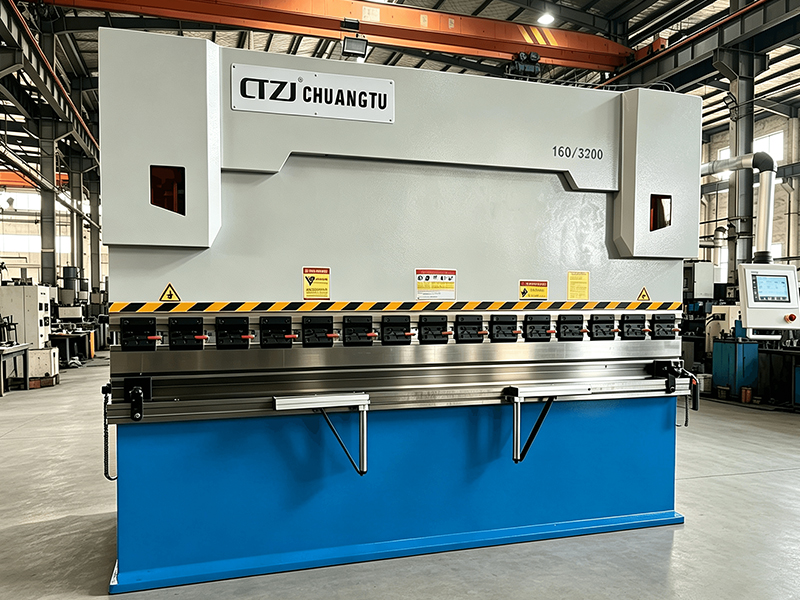
Mechanical Forced Synchronisation (open-loop)
A solid alloy steel torsion shaft at the rear of the machine body connects the left and right hydraulic cylinders via linkages; the mechanical torque of the shaft forcibly pulls the sliders on both sides downwards in synchronisation.
There is no real-time position detection; any deviation between the left and right sliders can only be offset by the rigidity of the torsion shaft, with no electronic automatic correction.
When subjected to unilateral loading, such as when bending long sheets, prolonged off-centre loading can cause slight deformation of the torsion shaft, leading to a gradual decline in synchronisation accuracy over time.
Electro-Hydraulic Servo Press Brakes (WE67K series)
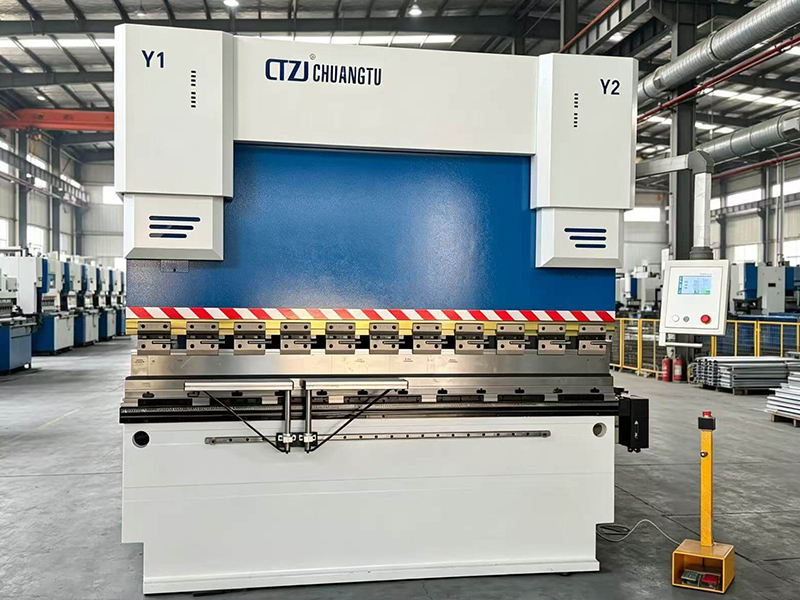
Electro-Dydraulic Closed-Loop Synchronisation (dual independent Y1/Y2 axes)
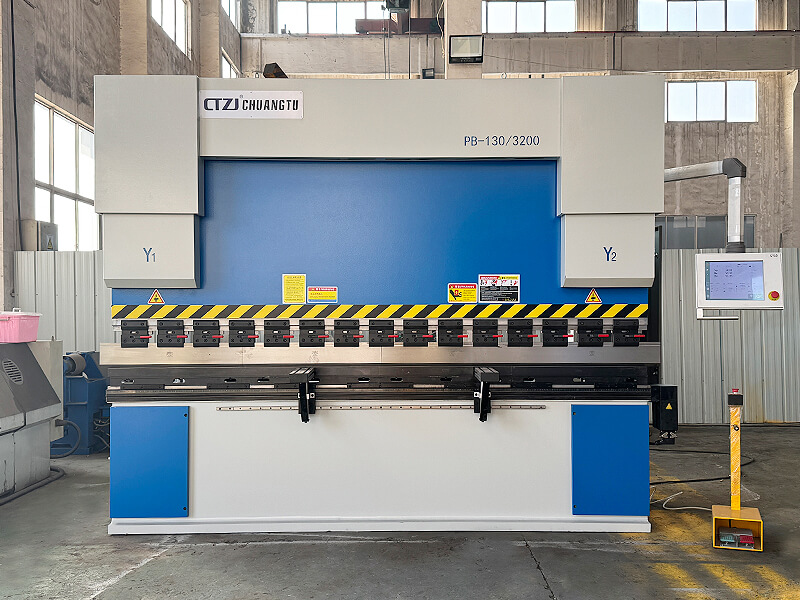
The torsion shaft has been eliminated, and the left and right hydraulic cylinders are controlled independently; Optical or magnetic encoders are installed on both sides of the ram to read left and right stroke positions in real time; the CNC system independently adjusts the oil flow to each side via servo proportional valves, automatically correcting left-right height differences within milliseconds.
The left and right cylinders operate in fully independent closed-loop control with real-time dynamic compensation, unaffected by uneven loading, machine body deformation or oil temperature.
Supports automatic deflection compensation (V-axis), ensuring consistent bending angles throughout the entire process when bending long or thick sheets.
Comparison Table of Key Parameters
| Comparison Criteria | CNC torsion-axis press brake | Electro-hydraulic servo press brake |
| Synchronisation Control | Mechanical torsion shaft forced synchronisation, open-loop | Dual-channel closed-loop system using a linear encoder and servo valve, with independent control of Y1 and Y2 |
| Repeatability | ±0.08–0.15 mm | ±0.01–0.05 mm |
| Off-centre bending capability | Poor; subject to force on one side only, the shaft is prone to twisting and deformation, resulting in inconsistent angles at both ends of long sheets | Excellent; capable of single-sided bending, handling extra-long sheets and automatically levelling thick sheets |
| Operating speed | Fast descent / return ≈ 80 mm/s, rear stop 100 mm/s; jerky transition between fast and slow speeds | Fast descent / return ≈ 200 mm/s, rear stop 300 mm/s; smooth operation, 30%–80% higher efficiency |
| Bending Consistency | Despite fluctuations in oil temperature and significant angular deviations during prolonged production | the system provides fully automatic compensation throughout the process, ensuring minimal angular error within the same batch of workpieces |
| Multi-operation programming | Basic 2–3 axes; multi-operation tasks require manual step-by-step setup | Standard configuration: 4+1/6+1/8+1 axes; graphical programming and automatic operation for continuous multi-step bending |
| Deflection Compensation | Mechanical compensation available as an option on higher-end models; no compensation on lower-end models | Standard CNC-controlled hydraulic automatic deflection compensation on the V-axis to counteract worktable deformation |
Analysis of the Advantages and Disadvantages of Torsion-Axis Press Brakes
Advantages
Low purchase cost; the preferred choice for small-scale workshops with limited budgets
Extremely simple structure with minimal hydraulic piping; few potential failure points and low maintenance costs, which can be handled by ordinary mechanics
Resistant to harsh workshop environments (dust, unstable voltage); not prone to sensor damage or machine downtime
Suitable for long-term batch production of single, simple workpieces; stable performance for centre-line bending operations
Disadvantages
No real-time closed-loop control; significant angle discrepancies at both ends of long sheets or single-sided bends, resulting in a higher scrap rate
Slow speed; low production efficiency for multi-step bending operations
No standard automatic deflection compensation; excessive bend angle in the centre of sheets longer than 3 metres
Long-term single-sided stress causes irreversible deformation of the torsion shaft, requiring disassembly and realignment at a later stage
Analysis of the Advantages and Disadvantages of Electro Hydraulic Servo Press Brake
Advantages
High precision and consistency, significantly improving yield rates for stainless steel, enclosures and precision sheet metal components
High speed and short cycle times, enabling higher production capacity for large-volume, complex bending operations
Supports automatic deflection compensation, ensuring uniform bending angles across the entire length of extra-long sheets (3–6 metres)
Graphical programming, bending simulation and multi-axis interpolation eliminate the need for repeated trial bends on complex workpieces, reducing reliance on skilled operators
High resistance to off-centre loading; no deviation occurs when bending thick sheets from one side or during segmented bending
Disadvantages
High purchase price for the entire machine; substantial initial investment
Linear encoders and servo proportional valves are precision components; oil contamination and dust can easily cause signal abnormalities
Higher maintenance costs; shorter replacement cycles for hydraulic oil, filter elements and seals; repairs require specialist CNC and hydraulic technicians
The servo electronic control system is complex; circuit faults are prone to occur in damp environments
Press Brakes Recommendations for Selecting Scenarios
Choose a torsion-axis press brake if you meet the following criteria
You have a limited budget, are a small workshop just starting out, and your orders mainly consist of short, medium-length, simple 90° bends
Your workpieces are uniform; you produce the same simple small parts—such as hardware components, hoardings and shelving—year-round, with very few extra-long sheets or single-sided bends
Your workshop environment is poor (high dust levels, unstable voltage), and you do not have specialist CNC maintenance personnel
Your machining accuracy requirements are moderate, and you are willing to allow a small number of test bends to adjust the angle
Choose an electro-hydraulic servo press brake if you meet the following criteria
You produce precision sheet metal, stainless steel, new energy enclosures, chassis and cabinets, medical equipment, and lift sheet metal components
You frequently bend sheets over 2.5 metres in length, thick sheets, perform single-sided off-centre bending, or execute complex multi-pass bends
You handle large batches with frequent product changes, prioritise high throughput and low scrap rates, and aim to minimise waste from trial bends
You require automatic compensation, graphic programming and multi-axis interpolation, and seek stable, consistent bending angles
You are focused on long-term development, value the sustained precision of the equipment, and do not wish to see a significant decline in machine accuracy after 2–3 years.