The ‘All-Rounder’ of The Plate Rolling Machine World – The Four Roller Plate Rolling Machine!
Blog 2026-07-25
In the world of modern industry, steel often gives the impression of being cold, hard and unyielding. But have you ever wondered how those massive wind turbine towers, pressure vessels and even the pressure hulls of submarines are transformed from flat sheets of thick steel into perfect cylinders or curved shapes?
Today, we’re going to meet the ‘steel plate magician’— four-roll plate rolling machine.
It’s hailed as the ‘handsome, rich and successful’ model of plate rolling machines.
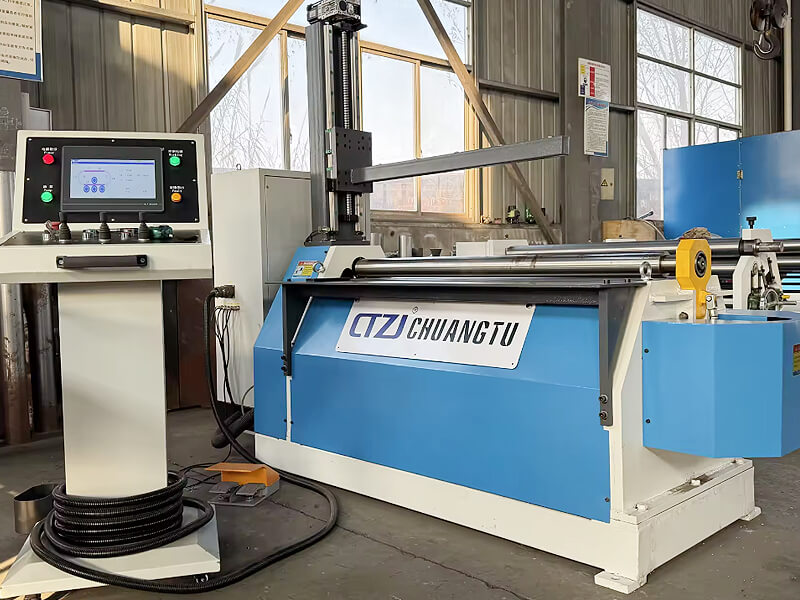
As the name suggests, a four-roll plate rolling machine features four key ‘large rollers’:
Upper roller: This acts as the ‘anchor’, remaining stationary whilst providing the primary rotational drive.
Lower roller: This is the ‘weightlifting champion’, capable of moving up and down to clamp the steel plate firmly in place.
Left and right side rollers: These are the ‘soul dancers’, moving along an inclined plane to roll the steel plate into the desired curvature.
Why is the four-roll plate rolling machine considered superior? The key lies in its ‘pre-bending’ capability.
Three-roll vs four-roll: which is the true king of efficiency?
With standard plate rolling machines, when rolling a sheet into a circle, there is always a small section at each end that cannot be rolled, leaving a straight edge at the end—much like a ‘plaster’ stuck onto a cylinder. This is not only unsightly but also affects the distribution of stress.
The key features of the four-roll plate rolling machine
Clamping: The lower roll rises to firmly ‘grip’ the leading edge of the steel plate.
Pre-bending: The side rolls apply pressure in unison, initiating the bending process right at the very edge of the plate.
Seamless operation: The plate remains under constant tension throughout the process; a single feed is sufficient to complete the pre-bending at both ends and the overall rolling, eliminating the need to pull the plate out and flip it over, as was required with older machines.
| Characteristics | Three-roll plate rolling machine (conventional) | Four-roll plate rolling machine (Modern) |
| Straight-edge residue | Longer processing time; secondary processing required | Extremely short, negligible |
| Difficulty of operation | Requires manual realignment on multiple occasions | CNC system, high degree of automation |
| Work efficiency | Lower | High |
| Safety | Plates are prone to slipping during movement | Safe and reliable |
Thanks to their precision, speed and reliability, four-roll plate rollers are at the forefront of the most demanding industries:
Wind power: Most of those hundred-metre-high towers are crafted by these machines.
Aerospace: Fuel tanks and fuselage skins.
Petrochemicals: Huge pressure vessels and reactors.
The four-roll plate rolling machine is not only a testament to power, but also a symbol of industrial precision. With the integration of computer numerical control (CNC) technology, it is now capable of rolling not only circles, but also U-shapes, multi-segment arcs and even conical shapes—truly living up to the saying, ‘If you can imagine it, it can roll it.’