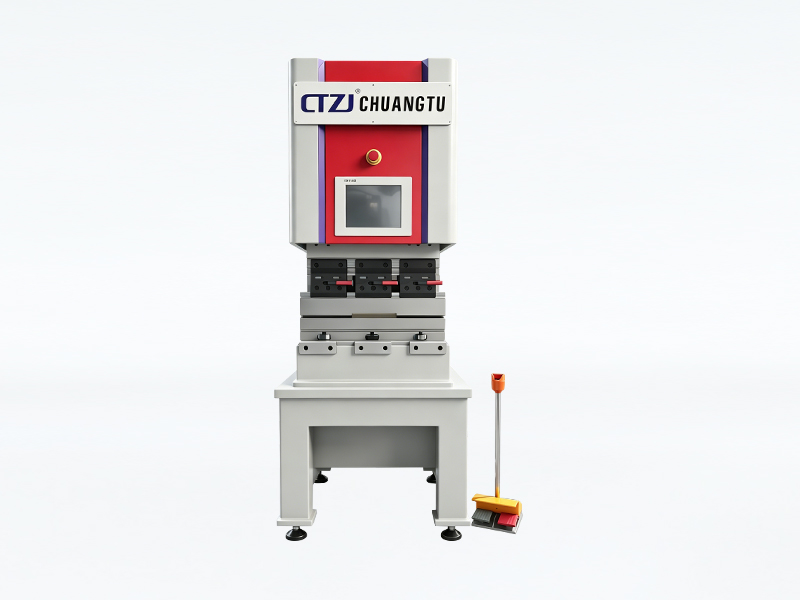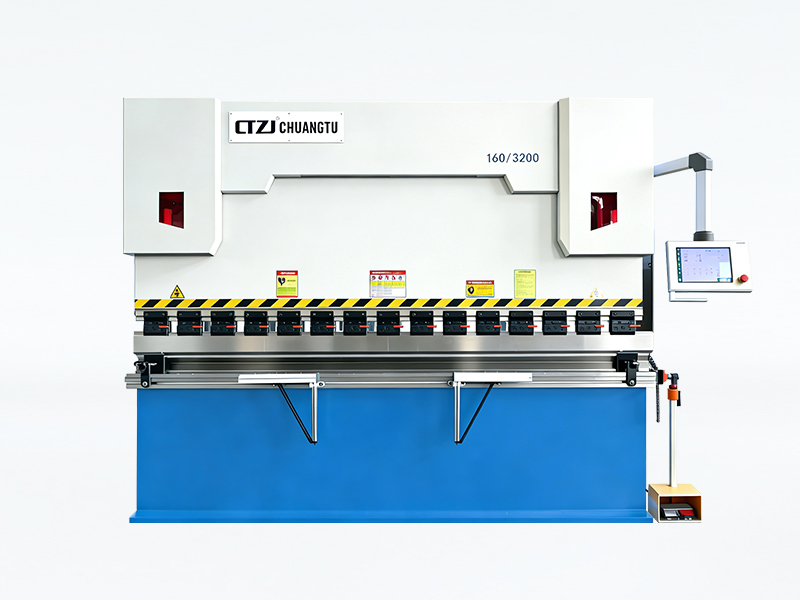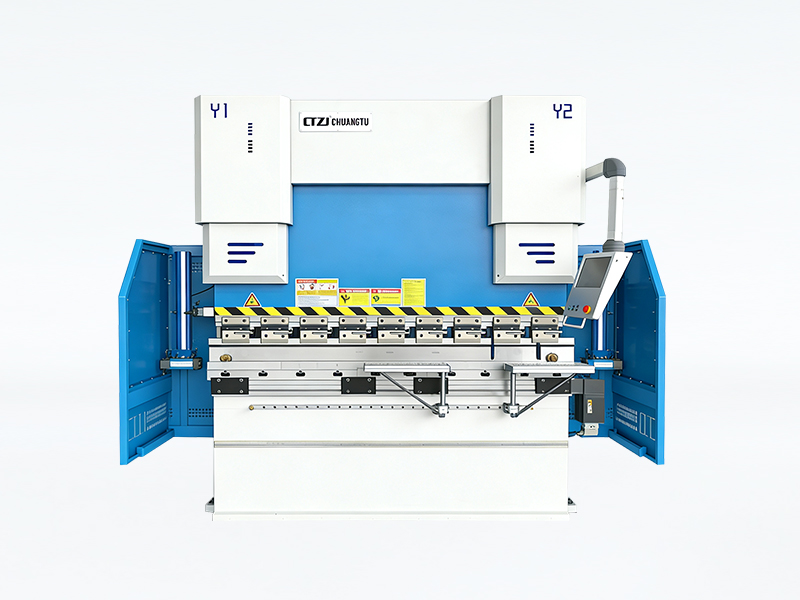
Small High Speed CNC Press Brake
Category:Press Brake
Bending length(mm): 2000
Column distance(mm): 1700
Throat Depth(mm):400
Mold height(mm): 450
Straightness(mm): ±0.03/m
Motor power(kw): 11
Product Details
Electro-hydraulic servo CNC press brakes are core equipment for mid- to high-end sheet metal bending and forming. They utilise dual independent servo proportional hydraulic cylinders combined with a full closed-loop electro-hydraulic synchronous control system based on a linear encoder, offering significant advantages in terms of synchronisation accuracy, off-centre bending, angle consistency, automation, energy efficiency, and the processing of long and thick sheets.
Comprehensive Safety Protection Features
Dual electrical and mechanical interlocks: safety light curtains, infrared protection at the blade edge; automatic emergency stop if a person is detected in the ram’s downward travel zone;
Foot switch, multi-point emergency stop buttons and guard door interlocks; bending operations are prohibited when the guard door is open;
Automatic machine lockout and alarm in the event of hydraulic overload, excessive oil pressure, overheating of the hydraulic oil, or synchronisation deviation exceeding limits;
Dual collision protection comprising ram return buffer stops and mechanical hard stops at the top and bottom, preventing damage to the die and hydraulic cylinders caused by overtravel;
Handheld mobile control panel, allowing the operator to remain clear of the hazardous cutting edge area whilst observing the bending process at close quarters
| Parameter | Unit | Parameter | Unit |
| Bending force(KN) | 1300 | Maximum backstop distance(mm) | 500 |
| Bending length(mm) | 2000 | X-axis and R-axis speed(mm/sec) | 400 |
| Column distance(mm) | 1700 | X- and R-axis accuracy(mm) | ±0.025 |
| Throat Depth(mm) | 400 | Number of front pallets | 2 |
| Cylinder stroke(Y1+Y2) | 200 | Back stop finge | 3 |
| Mold height(mm) | 450 | Motor power(kw) | 11 |
| Y-axis downward speed(mm/sec) | 120 | length(mm) | 2300 |
| Y-axis return speed(mm/sec) | 100 | width(mm) | 2100 |
| Y-axis working speed(mm/sec) | 4~15 | height(mm) | 2900 |
| Y-axis accuracy(mm) | ±0.01 | Weight(kg) | 7000 |
| Straightness(mm) | ±0.03/m |
Frequently Asked Questions
We usually dispatch the goods within 30 days. If the machine is a non-standard, custom-made product, it may take longer. Generally speaking, the delivery time will not exceed 50 days.
We generally accept payment by telegraphic transfer (T/T) and letter of credit (L/C), requiring a 40% deposit, with the remaining 60% to be paid in full prior to delivery. For specific clients, we can offer more flexible payment terms.
The warranty period for the equipment is one year, with lifetime support provided. For specialised, non-standard equipment, we may offer a longer warranty period. During the warranty period, we provide free servicing should the equipment develop any quality issues or require replacement parts.
We do offer OEM customisation services, including customisation of appearance, dimensions and performance specifications. Please note that the price of customised equipment may be slightly higher. If you would like to find out more about our OEM services, please contact us.
Whether standard or customised, the minimum order quantity is one unit, and we can meet your specific requirements through our OEM services.
Upon delivery of the equipment, we usually provide various manuals, operating instructions, safety precautions, circuit diagrams and other documentation.
Sea freight charges are usually determined by the freight forwarder. You can choose to arrange transport through our freight forwarder, or select your own freight forwarder.
We can provide after-sales support, including commissioning, training and maintenance, to customers worldwide; however, customers are required to cover the costs of our technical engineers.
Chuangtu is keen to collaborate with ambitious teams. We offer comprehensive technical and pricing support to help you develop the market. If you are interested, please contact us so we can discuss this further.
We generally opt for sea freight. If a customer orders small equipment, we will ship it via less-than-container load (LCL); if a customer orders one or more medium-sized or large items in a single order, we will pack them into a container and transport them to the port, which will help the customer save on costs.